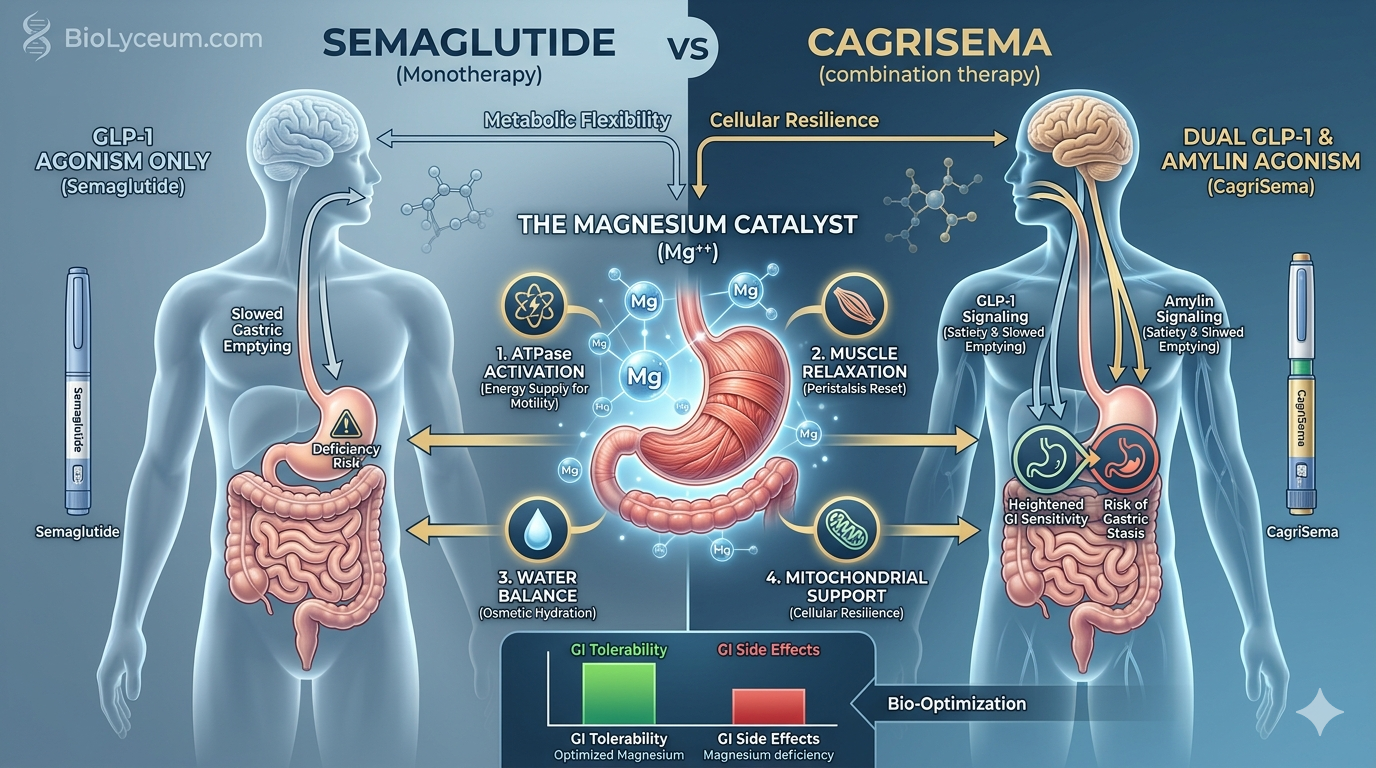
CagriSema emerges in 2026 as the potent dual-agonist successor to Semaglutide, clinical data from the REDEFINE trials reveals a significant uptick in gastrointestinal sensitivity due to the combined slowing effects of GLP-1 and Amylin analogues.
BioLyceum’s analysis identifies Magnesium as the indispensable biological catalyst required to overcome drug-induced gastric stasis and maintain cellular resilience.
Optimizing intracellular Magnesium is no longer a “supplemental choice” but a metabolic requirement for anyone seeking the weight-loss benefits of CagriSema without the debilitating GI side effects.
1. The 2026 Metabolic Frontier: Beyond Semaglutide to CagriSema
The landscape of bio-optimization has shifted. While Semaglutide (Ozempic/Wegovy) redefined weight management, 2026 marks the dominance of CagriSema—a fixed-dose combination of Semaglutide and Cagrilintide. By targeting both the GLP-1 and amylin pathways, CagriSema offers superior ATP efficiency and weight loss.
With recent REIMAGINE 2 trials showing up to 14.2% weight reduction in diabetic adults.
However, this increased potency comes with a biological “tax.” Dual-agonism creates a “Semaglutide-squared” effect on the gut. While Semaglutide alone slows gastric emptying, the addition of an amylin analogue further decelerates the passage of food through the brainstem signaling pathways.
For the high-performance individual, this can manifest as a collapse in metabolic flexibility, where the body struggles to process nutrients effectively, leading to heightened nausea and vomiting.
2. Magnesium: The Biological Catalyst for Gastric Resilience
To understand why GI side effects are so prevalent with CagriSema (occurring in nearly 80% of clinical trial participants), we must look at the mechanics of cellular resilience.
Gastric motility is an energy-intensive process that relies on the coordinated contraction and relaxation of smooth muscle.
Magnesium is the essential cofactor for the Na-K-ATPase pump, the enzyme responsible for creating the electrical gradient that allows muscles to contract. When GLP-1 and Amylin analogues send a pharmacological signal to “slow down,”.
a system deficient in Magnesium lacks the “reset button” needed for the next wave of peristalsis. This leads to Gastric Stasis, where Food remains in the stomach too long, fermenting and causing the dreaded “sulfur burps.”
Osmotic Dehydration:
Magnesium is required to pull water into the intestines; without it, the slowed transit results in severe, dry constipation.
Mitochondrial Mismatch:
The gut lining requires immense ATP to maintain its barrier. Magnesium deficiency impairs mitochondrial markers, leaving the GI tract vulnerable to inflammation.
3. GLP-1 Companion Nutrition: Senolytics and Mitochondrial Markers In 2026.
The gold standard for peptide therapy isn’t just the injection; it’s the GLP-1 companion nutrition protocol.
Sophisticated users are now integrating Senolytics like Fisetin and Quercetin to clear senescent “zombie cells” that impede metabolic recovery.
However, these senolytic interventions are only as effective as the mineral substrate they inhabit.
Magnesium stabilizes DNA and supports the mitochondrial biogenesis triggered by senolytics. Without optimized Magnesium levels, the metabolic stress of CagriSema can lead to “metabolic gray zones” where weight is lost, but mitochondrial health—measured by ATP efficiency—declines.
By maintaining high Magnesium status, you ensure that the rapid weight loss doesn’t come at the cost of your long-term cellular health.
4. The “Metabolic Synergy” Section: Magnesium as the Longevity Bridge.
At BioLyceum, we view minerals not as passive electrolytes, but as the foundational bridge to metabolic longevity. Magnesium is involved in over 300 enzymatic reactions, including the regulation of insulin sensitivity and heart rate variability (HRV).
When using CagriSema, your body undergoes a massive metabolic reorganization. As fat stores are liberated, the demand for Magnesium to process these fatty acids increases. This creates a “Mineral Sink” effect. If you don’t refill the sink, your HRV drops, your sleep quality degrades, and your GI tolerability vanishes.
Magnesium optimization ensures that the body remains in a state of metabolic flexibility, allowing you to switch between fuel sources while the medication manages your satiety. To understand more on the topic you can check this complete evidence based guide on Magnesium and follow the references journal.
The BioLyceum Standard: A successful CagriSema protocol isn’t measured by the scale alone, but by the absence of GI distress and the maintenance of lean tissue—both of which are Magnesium-dependent processes.
Key Takeaways for Mineral-Optimized GLP-1 Therapy
Switch to High-Bioavailability Forms of Magnesium
Avoid Magnesium Oxide, which can worsen GI irritation. Opt for Magnesium Glycinate for sleep and gut calm, or Magnesium Malate to support ATP efficiency during the day.
Pulse Your Senolytics:
Integrate Fisetin or Quercetin on a monthly cycle to support cellular housekeeping while on CagriSema.
Hydrate with Trace Minerals:
Peptides are “water-demanding.” Supplementing with a broad-spectrum mineral complex prevents the “flat” look associated with rapid weight loss.
The “Slow-Motion” Rule:
If nausea hits, it’s a signal of Magnesium-calcium imbalance. Increasing your Magnesium-to-Calcium ratio can help relax the pyloric sphincter and ease gastric transit.
Before starting your dual-agonist journey, verify your baseline cellular resilience with a Magnesium Test at home
4. The Innovation: The next frontier in metabolic health: Cagrilintide-Semaglutide