Can You Take Lithium Orotate with Magnesium L-Threonate? Safety, Synergies, and Dosing Protocols
In the landscape of modern neurobiology and cognitive optimization, few supplement pairings attract as much interest—and clinical nuance—as low-dose lithium orotate and magnesium L-threonate.
Both compounds act as powerful modulators of central nervous syste
m (CNS) function. However, because both influence intracellular signaling, neurotransmitter activity, and ionic balance within the brain, combining them requires a clear understanding of their mechanisms, potential synergies, and safety boundaries.
This article breaks down the biochemical rationale for stacking lithium orotate with magnesium L-threonate, examines how they navigate the blood-brain barrier (BBB), outlines timing protocols, and addresses key safety considerations.
1. Cellular Mechanics: Blood-Brain Barrier & Transport
To understand how these two molecules interact, we must first look at how they enter central nervous system tissue.
Lithium Orotate
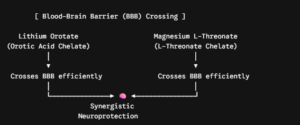
Lithium in high clinical doses (e.g., lithium carbonate at 300 mg–900 mg) is a standard pharmaceutical intervention for mood stabilization [1]. However, at elemental microdoses (typically 1 mg to 5 mg), lithium orotate pairs elemental lithium with orotic acid. Orotate serves as a biological carrier, allowing the lithium ion to penetrate cellular membranes and cross the blood-brain barrier at significantly lower concentrations than inorganic lithium salts [2].
Magnesium L-Threonate
Standard forms of magnesium—such as citrate, oxide, or glycinate—are effective for systemic needs, but they exhibit limited capacity to elevate brain magnesium concentrations due to transport limits across the blood-brain barrier [3]. Magnesium L-Threonate (Magtein) was specifically developed to overcome this restriction. L-threonate, a vitamin C metabolite, acts as a targeted chelating agent that increases cerebrospinal fluid (CSF) magnesium concentrations far more effectively than other magnesium salts [3].
When taken together, both compounds bypass systemic saturation limits to deliver active mineral ions directly into neural tissue.
2. Neurochemical Synergies: How They Work Together
When present together in the CNS, lithium orotate and magnesium L-threonate target complimentary pathways involved in synaptic plasticity, mood regulation, and neuroprotection.
A. NMDA Receptor Modulation & Neuroprotection
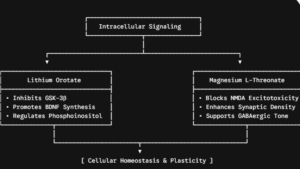
Magnesium’s Role: Under baseline physiological conditions, magnesium sits inside the pore of the N-methyl-D-aspartate (NMDA) receptor, acting as a natural voltage-dependent ion channel blocker [4]. This prevents excessive intracellular calcium influx, protecting neurons from excitotoxicity caused by overstimulated glutamate pathways.
Lithium’s Role: Low-dose lithium complements this mechanism by downregulating hyperactive NMDA receptor signaling and modulating intracellular signaling cascades downstream of glutamate binding [5].
Together, they provide a dual-layer defense against glutamate-induced neurotoxicity, which is frequently implicated in chronic stress, anxiety, and cognitive fatigue.
B. GSK-3β Inhibition & BDNF Upregulation
Glycogen Synthase Kinase-3 Beta (GSK-3β) is an enzyme whose overactivity is tied to neuroinflammation, tau hyperphosphorylation, and cellular apoptosis [6].
Lithium directly inhibits GSK-3β activity, which upregulates Brain-Derived Neurotrophic Factor (BDNF)—a primary protein responsible for neurogenesis and long-term potentiation (LTP) [6].
Magnesium L-Threonate independently increases structural synaptic density and density of functional synapses in the hippocampus by enhancing NMDA receptor subunit expression (specifically NR2B) [3].
Combining the two creates a favorable intracellular environment for structural plasticity and cellular repair.
| Parameter | Lithium Orotate | Magnesium L-Threonate |
| Typical Elemental Dose | 1 mg – 5 mg elemental lithium | 144 mg elemental Mg (~2,000 mg compound) |
| Primary Target | Mood stabilization, GSK-3β inhibition | Synaptic density, spatial memory, relaxation |
| Optimal Timing | Late afternoon or Evening | Evening (1-2 hours before sleep) |
| Action Mechanism | Signal transduction modulation | NMDA receptor channel blockade |
Suggested Protocol Strategies
Strategy A: Evening Sleep & Wind-Down Protocol
Taking both compounds in the evening aligns well with natural circadian rhythms.
Lithium Orotate: 2.5 mg – 5 mg taken with dinner.
Magnesium L-Threonate: 1,400 mg – 2,000 mg (supplying ~100 mg–144 mg elemental magnesium) taken 60 minutes before bed.
Rationale: Lithium orotate helps quiet repetitive cognitive loops, while magnesium L-threonate supports GABAergic tone and lowers baseline neuronal excitability, preparing the brain for deep sleep stages.
Strategy B: Split Daily Protocol (For Daytime Focus & Mood)
Morning / Midday: 1 mg – 2.5 mg Lithium Orotate with food.
Evening: Full dose of Magnesium L-Threonate prior to sleep.
Rationale: Separating the dosages avoids excessive daytime lethargy while still allowing continuous neuroprotective cover throughout the 24-hour cycle.
4. Safety Considerations & Potential Interactions
While low-dose lithium orotate and magnesium L-threonate are available over the counter, stacking them requires attention to safety fundamentals.
1. Renal Excretion Mechanics
Both lithium and magnesium rely heavily on the kidneys for clearance [1, 4].
Hydration: Adequate water intake and electrolyte balance are mandatory. Dehydration causes the renal proximal tubules to reabsorb more sodium and lithium simultaneously, which can spike blood concentrations of lithium.
Renal Function: Anyone with impaired kidney function (e.g., chronic kidney disease) should avoid this stack unless directly monitored by a physician.
2. Interaction with Prescription Medications
SSRIs / SNRIs: Combining lithium orotate—even at low doses—with serotonergic agents increases the theoretical risk of serotonin syndrome, as lithium enhances presynaptic serotonin release [5].
Diuretics & ACE Inhibitors: Medications that alter sodium excretion or renal hemodynamics significantly alter lithium clearance rates.
Pharmaceutical Lithium Warning: Lithium orotate must never be used as a self-directed replacement for prescribed lithium carbonate or lithium citrate.
3. Mild Side Effects to Watch For
Initial lethargy or brain fog (often resolved by reducing the lithium dose or shifting all intake to bedtime).
Mild gastrointestinal upset (typically tied to magnesium compounds; taking with food helps mitigate this).
Summary Recommendations
Start Low and Titrate Slowly: Begin with a minimal dose of elemental lithium orotate (1 mg – 2.5 mg) alongside a half-dose of magnesium L-threonate for the first 7–10 days.
Prioritize Evening Administration: Given their combined relaxing effect on central excitatory pathways, the evening hours are optimal for most users.
Monitor Hydration: Keep fluid and sodium levels stable to support normal renal excretion.
Consult a Healthcare Professional: If taking prescription psychiatric or cardiovascular medications, review this protocol with a qualified healthcare provider prior to initiation.
References
Geddes, J. R., & Miklowitz, D. J. (2013). Treatment of bipolar disorder. The Lancet, 381(9878), 1672-1682.
Kling, M. A., et al. (1978). Orotate as a carrier moiety for lithium ions: Cellular distribution and pharmacological effects. Journal of Pharmaceutical Sciences, 67(7), 887-892.
Slutsky, I., Abumaria, N., Wu, L. J., Huang, C., Zhang, L., Li, B., … & Liu, G. (2010). Enhancement of learning and memory by elevating brain magnesium. Neuron, 65(2), 165-177.
Muralidharan, A., et al. (2020). The role of magnesium in neurological disorders: A biochemical perspective. Nutritional Neuroscience, 23(8), 601-614.
Chiu, C. T., & Chuang, D. M. (2010). Molecular actions of lithium in the CNS: Probing neuroprotective mechanisms. Trends in Molecular Medicine, 16(12), 585-592.
Eldar-Finkelman, H., & Martinez, A. (2011). GSK-3 inhibitors: Development and therapeutic potential. Frontiers in Molecular Neuroscience, 4, 32.