Can Blocking Mitochondrial Magnesium Prevent Weight Gain? What the Cell Reports Mouse Study Actually Shows
📝 Editor’s Correction (Updated September 2026): An earlier version of this article misstated the findings of the 2023 Cell Reports study, including an incorrect compound name (“Mg18”) and a reversed mechanism. The article has been fully rewritten by the author to accurately reflect the published research on the Mrs2 mitochondrial magnesium channel and the compound CPACC. We correct our record openly — no hype, just measurements.
Key Takeaways
- A 2023 Cell Reports study found that limiting magnesium entry into mitochondria (via the Mrs2 channel) prevented weight gain and fatty liver in mice fed a Western diet for up to 52 weeks.
- The compound used, CPACC, blocks mitochondrial magnesium transport. It is a patented drug candidate — not a supplement you can buy.
- This was a mouse study. No human trials exist yet.
- Crucially: this does NOT mean magnesium supplements cause weight gain, nor that taking magnesium burns fat. Systemic dietary magnesium remains essential for over 300 enzymatic reactions.
Why the Headlines Are Misleading :
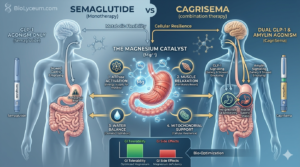
When news sites wrote “magnesium drug melts fat on a junk-food diet,” many readers concluded they should buy magnesium for weight loss. The science says nearly the opposite: inside mitochondria, excess magnesium acts like a metabolic brake. Researchers reduced that mitochondrial magnesium — genetically, and later pharmacologically — and only then did metabolism speed up.
The Real Mechanism: Mrs2, the Mitochondrial Magnesium Gate
Magnesium enters mitochondria through a channel encoded by the MRS2 gene. In mice lacking MRS2, cells burned sugar and fat more efficiently, white fat showed “browning,” and citrate export for fat synthesis decreased. Despite eating the same Western diet, knockout mice stayed lean and avoided fatty liver, fibrosis, and liver tumors.
CPACC: The Drug That Mimics the Genetic Effect
The team then tested CPACC, a small molecule that blocks magnesium transport through the same pathway. In mice on a high-fat diet, injections every three days for six weeks limited weight gain and improved liver function markers. UT Health San Antonio has filed a patent application; co-inventors include researchers at the University of Pennsylvania and Cornell.
What This Means for You Today:
Nothing (Yet) Let’s be honest about limitations:
- Mice are not humans. Global MRS2 knockout cannot isolate tissue-specific effects.
- CPACC was injected, not taken orally, and is years away from human safety trials.
- Mitochondrial magnesium ≠ dietary magnesium. Your blood and cellular magnesium status is tightly regulated and essential. Nothing here justifies stopping or mega dosing any supplement.
The Bottom Line Mitochondrial magnesium transport is a genuinely promising research target for obesity, fatty liver disease, and cardiometabolic conditions. But promising target ≠ proven therapy. Until human trials exist, the evidence-based approach to magnesium remains unchanged: meet your RDA through food and, if needed, well-absorbed supplemental forms. To understand evidence based mechanism of Magnesium supplementation you can check our other articles.
References
- Madaris, T.R., Venkatesan, M., … Madesh, M. (2023). Limiting Mrs2-dependent mitochondrial Mg2+ uptake induces metabolic programming in prolonged dietary stress. Cell Reports, 42(3), 112155. https://doi.org/10.1016/j.celrep.2023.112155
- UT Health San Antonio (2023). Novel drug makes mice slim even on sugary, fatty diet. https://news.uthscsa.edu/novel-drug-makes-mice-slim-even-on-sugary-fatty-diet-3/
- Ponnusamy, T., Velusamy, P., Shanmughapriya, S. (2024). Mrs2-mediated mitochondrial magnesium uptake… Mitochondrion. https://doi.org/10.1016/j.mito.2024.101877