Magnesium: The Complete Evidence-Based Guide — Types, Dosage, Benefits & the 2026 Label Audit
Magnesium is a cofactor in more than 300 enzyme systems — by some counts closer to 600 — including energy production, muscle relaxation, nerve signaling and blood-sugar control. Roughly half of adults in the United States eat less than the Estimated Average Requirement. The RDA is 400–420 mg/day for men and 310–320 mg/day for women; the upper limit for supplemental magnesium is 350 mg/day. Glycinate is the gentlest form, citrate the most osmotic, oxide the cheapest and worst absorbed. And according to our September 2026 audit of twelve best-selling brands, the price of 100 mg of real, elemental magnesium ranges from $0.08 to $0.26 depending on which logo you trust.
Every green leaf you have ever eaten contains magnesium at its center. It is the metal atom sitting in the middle of the chlorophyll molecule, holding photosynthesis together. The element even takes its name from Magnesia, a district in ancient Greece — the same place that gave us the words “magnet” and “manganese.”
And yet, for something this central to biology, magnesium is astonishingly easy to get wrong. Labels confuse compound weight with elemental weight. Blog posts promise cures that trials never demonstrated. Meanwhile the actual science — the RCTs, the meta-analyses, the mechanism papers — is more interesting than the hype, not less.
This guide is our attempt to put all of it in one place: what magnesium does, what deficiency really looks like, which form to choose, how much to take, what the trials actually show for sleep, anxiety, migraines and cramps, and how to read any label in thirty seconds. Where the evidence is strong, we say so. Where it is thin, we say that too.
Ask what magnesium does and most articles hand you a list. Let’s do something better: let’s follow one atom.
The magnesium you swallow ends up in one of three places. About 60% goes to bone, where it acts as a structural reserve. Around 39% enters muscle and soft tissue. And a mere 1% stays in blood serum — which, as we’ll see, is exactly why blood tests are so bad at catching deficiency.
Inside your cells, magnesium’s main job is being the partner your energy currency cannot function without. ATP — the molecule that powers essentially every cellular transaction — is biologically inactive alone. It must bind magnesium to become Mg-ATP. Every heartbeat, every thought, every muscle contraction you have ever had was paid for in magnesium-bound ATP.
Beyond energy, magnesium (de Baaij et al., 2015):
Calms the nervous system by regulating NMDA receptors and supporting GABAergic tone — the brain’s braking system
Relaxes muscle by acting as a natural calcium antagonist at the cell membrane
Stabilizes blood sugar by participating in insulin signaling and glucose metabolism
Shapes bone quality, not just bone density, by influencing hydroxyapatite crystal formation
Modulates inflammation, with low status associated with elevated CRP in observational data
One mineral, five systems. That is why deficiency never shows up as a single dramatic symptom. It shows up as noise: poor sleep, twitchy eyelids, cramps, irritability, stubborn blood sugar. More on that next.
Magnesium Deficiency: Real Symptoms vs. Internet Hype
Here is the uncomfortable truth about magnesium testing: a normal blood magnesium level does not mean you are replete. Serum contains about 1% of total body magnesium, and your body defends that 1% fiercely — pulling mineral out of bone to keep blood levels stable. So serum magnesium stays “normal” long after tissue stores have fallen (National Institutes of Health, Office of Dietary Supplements, 2025).
Clinicians who care about status use better tools:
RBC magnesium (red-cell content) — imperfect, but closer to tissue stores than serum
Ionized Mg²⁺ — the free, active fraction
EXA test (cheek-cell mineral content) — emerging, not yet mainstream
And honestly? For most people the cheapest first screen is a symptom pattern plus a diet review. Which brings us to what deficiency actually looks like.
Signs with real evidence behind them:
muscle cramps and tremors, insomnia and fragmented sleep, migraine frequency, insulin resistance, palpitations and arrhythmia risk, and in prolonged deficiency, low calcium and potassium that refuse to correct until magnesium is replaced.
Signs the internet invented:
“fatigue” on its own (nonspecific — a thousand causes), “chocolate cravings prove deficiency” (charming, unproven), and “eyelid twitch means you need 500 mg tonight” (usually it means you need sleep).
How common is suboptimal intake? Intake surveys are blunt instruments, but the consistent picture from NHANES analyses is that roughly half of the US population consumes less than the Estimated Average Requirement (Rosanoff et al., 2016). Not half are clinically deficient — most are simply running low, chronically, in the zone where subtle symptoms live.
If you want a structured first look, our free magnesium deficiency assessment walks through the ten-question symptom and diet screen we use in practice.
The Seven Types of Magnesium, Compared
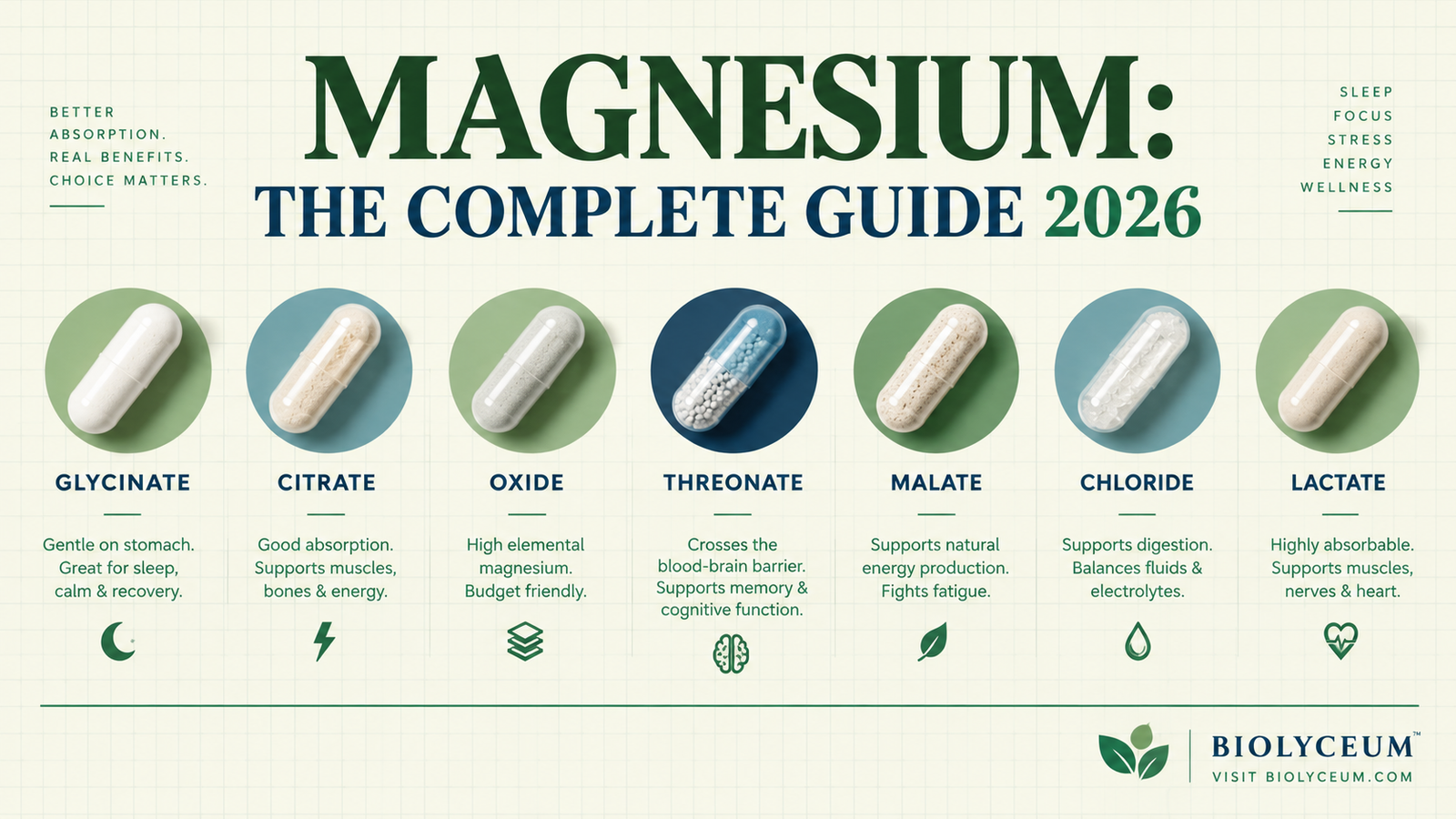
Walk a supplement aisle and you’ll face a wall of “-ates”: glycinate, citrate, oxide, malate, threonate, chloride, lactate. They are not interchangeable. The molecule magnesium is bonded to changes absorption, tolerance and purpose.
Form
% Elemental
Best For
GI Tolerance
Glycinate
10–14%
Sleep, calm, long-term repletion
Excellent
Citrate
11–16%
Constipation, budget absorption
Good (osmotic at dose)
Oxide
~60%
Cheap bulk mg (poorly absorbed)
Poor
L-Threonate
~8%
Cognitive claims (early evidence)
Good
Malate
~11–15%
Energy, fibromyalgia protocols
Good
Chloride (topical)
~12%
Baths, topical use
N/A (weak systemic data)
Lactate
~12%
GI-sensitive users
Good
A few teaching points the table can’t say out loud:
1. Magnesium Glycinate is the diplomat.
Chelated to two glycine molecules, it absorbs well and rarely upsets the gut — which is why it dominates sleep and anxiety formulations, and why we audited it separately in our 2026 magnesium glycinate label audit.
2. Magnesium Citrate is the plumber.
Genuinely useful when constipation is part of the picture; less charming when it isn’t.
3. Magnesium Oxide is the trap.
At ~60% elemental it looks like the best deal on the shelf. It is the worst-absorbed common form and the classic cause of supplement-induced diarrhea. You are buying milligrams your intestine refuses.
4. Magnesium Threonate is the interesting one.
In rodents, magnesium L-threonate raised brain magnesium and improved learning metrics (Slutsky et al., 2010). Human data remain small and industry-funded. Promising, not proven. We’d call it a bet, not a prescription.
5. Magnesium malate is the energy for the Cell, Muscle and Remove fatigue.
Magnesium malate is magnesium bound to malic acid, a molecule involved in cellular energy production. It is often chosen for fatigue, muscle discomfort, and fibromyalgia-style protocols, although the evidence is still more preliminary than for sleep or migraine uses.
6. Magnesium Chloride is the bath salt.
Transdermal magnesium is beloved online and weakly supported in labs: a pilot study found only modest changes in mineral status after weeks of topical application (Kass et al., 2017). Enjoy the bath; don’t count it as your dose.
7. Magnesium lactate — gentle oral form for sensitive stomachs.
Magnesium lactate is a gentler oral form sometimes used when people do not tolerate oxide or citrate well. It is not flashy, but it is useful when the goal is steady repletion without upsetting the stomach.
What Trials Actually Show: Magnesium’s Benefits by Condition
This is the section most supplement blogs get wrong, because the honest answer varies by condition. Let’s go condition by condition.
Magnesium for Sleep
The mechanism is clean: magnesium supports GABAergic tone and dampens NMDA-driven excitability, and low status correlates with poor sleep architecture. The trial data? Better than you’d expect for a supplement.
In a double-blind, placebo-controlled trial of elderly patients with insomnia, 500 mg of magnesium daily for eight weeks improved sleep efficiency, sleep time, and sleep-onset latency, while raising melatonin and lowering cortisol (Abbasi et al., 2012). An earlier landmark study found that oral magnesium supplementation partially reversed age-related changes in sleep EEG and neuroendocrine markers (Held et al., 2002).
Two honest caveats. First, both trials were small. Second, the sleep benefit tracks best in people who start out low — magnesium is not a sedative, it’s a correction. Practical protocol: 200–400 mg elemental as glycinate, 30–60 minutes before bed, measured over weeks, not nights. Our full breakdown lives in the sleep section of the magnesium glycinate supplements guide.
Magnesium for Anxiety and Depression
The GABA story makes magnesium an obvious candidate for anxiety, and mechanistic work supports the link between deficiency and heightened stress-responsiveness (Kirkland et al., 2018). Human trial evidence is more modest: a systematic review of magnesium and emotional functioning found small positive signals but flagged most studies as low quality (Boyle et al., 2017).
For depression, the literature includes striking case-series reports of rapid recovery with magnesium treatment (Eby & Eby, 2006) alongside smaller RCTs with mixed results. Our reading, as scientists and not sellers: magnesium is a reasonable, low-risk adjunct for mood — never a replacement for therapy or prescribed medication. If you are on an SSRI or SNRI, keep taking it, and add magnesium only in conversation with your prescriber. The deeper evidence review is in our magnesium and mental health guide.
Magnesium for Migraines
This is one of the few places a guidelines body has formally endorsed magnesium. The American Academy of Neurology’s evidence-based guideline rated magnesium as “probably effective” for migraine prevention, and the classic RCT used 600 mg/day of oral magnesium with a significant reduction in attack frequency versus placebo (Peikert et al., 1996).
The catch is patience: benefit builds over roughly three months. Magnesium is prevention, not rescue. If you get an aura-rich migraine at 2 pm, a tablet will not abort it.
Magnesium for Muscle Cramps and Athletes
Time for an unpopular finding: for ordinary, idiopathic leg cramps, the Cochrane review found no clear benefit of magnesium over placebo in the general population (Garrison et al., 2012). The internet loves magnesium for cramps; the best evidence says “probably not” for most people.
Where it does plausibly help: athletes training hard in heat, people with genuinely low status, and pregnancy-associated cramps where the evidence remains uncertain but clinically encouraging. If you cramp and your magnesium intake is poor, correcting intake is worth eight weeks of honest observation. If you cramp and your intake is fine, look elsewhere — hydration, sodium, load management.
Magnesium for Blood Sugar and Metabolic Health
Quietly, this may be magnesium’s most important story. Prospective cohort data show an inverse dose-response between magnesium intake and type 2 diabetes risk (Dong et al., 2011), and mechanistic work ties low status to insulin resistance (Barbagallo & Dominguez, 2015). Even the odd-looking headlines — like the 2026 Cell Reports coverage of a magnesium-linked compound driving fat loss in animal models — sit on this same metabolic foundation. Our analysis of that study is in the magnesium fat-loss research breakdown.
MAGNESIUM: THE COMPLETE GUIDE 2026,
Dosage: How Much Magnesium Per Day, Really?
Three numbers, and the confusion between them causes most overdosing and most underdosing:
The RDA — 400–420 mg/day for men, 310–320 mg/day for women (350–360 mg in pregnancy), counting food plus supplements (NIH ODS, 2025).
What trials use — typically 200–400 mg elemental per day, usually split.
The supplemental upper limit — 350 mg/day from supplements alone, set not because of toxicity but because of the osmotic diarrhea threshold.
Notice what that third number means: several popular products’ “suggested servings” sit above the UL. Not illegal. Not automatically dangerous. Just a choice you should make knowingly — which is exactly what our audit table lets you do. before buying or using any brands Magnesium supplement you should check the Magnesium label calculator to know the price of per 100 Mg Magnesium.
Split-dose for Magnesium rule of thumb:
a smaller share with breakfast, the larger share in the evening. It improves gut tolerance, mirrors trial dosing, and aligns the peak with sleep-onset mechanics.
Now let’s take each form individually, with the two numbers readers actually need: how much to take, and what happens if you take too much.
1. Magnesium Glycinate: Dosage and Side Effects
Typical dosage: 200–400 mg elemental per day, split into two doses. For sleep protocols, 200–300 mg elemental taken 30–60 minutes before bed matches the timing used in the insomnia trials. Because glycinate is roughly 10–14% elemental by weight, that usually means 1–4 capsules — always check the panel, never the front label.
Side effects: The gentlest of the common forms. Loose stools appear only at unusually high doses, since the glycine chelate bypasses much of the osmotic load that causes diarrhea. Occasional reports of mild drowsiness are anecdotal and, frankly, often the desired effect. The universal caution applies: impaired kidneys change everything, so renal disease means medical supervision first.
2. Magnesium Citrate: Dosage and Side Effects
Typical dosage of Magnesium Citrate : 150–300 mg elemental per day for general supplementation, taken with food and a full glass of water. Higher single doses belong to its other career — saline laxative territory — and should only be used occasionally, not as a daily mineral strategy.
Side effects: This is the form where dose and discomfort meet fastest. Loose stools, cramping and urgency are common as doses climb, because unabsorbed citrate pulls water into the bowel. Chronic laxative-level use can also drag potassium and calcium down with it. If citrate gives you trouble at modest doses, that’s not a deficiency symptom — it’s osmotic chemistry doing exactly what it does.
3. Magnesium Oxide: Dosage and Side Effects
Typical dosage: Labels often shout 250–500 mg, but remember oxide is ~60% elemental while absorbing poorly — so the usable fraction is smaller than it looks, and much of the rest never leaves your intestine. If you use oxide at all, keep elemental intake modest (under 200–300 mg), take it with meals, and treat it as a budget option or short-term antacid rather than a repletion tool.
Side effects: The highest diarrhea rate of any common form, plus cramping and, with chronic laxative use, dehydration and electrolyte losses. Oxide’s side-effect profile is essentially its absorption profile viewed from the other end.
Typical dosage: Human studies have used roughly 1,500–2,000 mg of the compound per day, split morning and evening — which delivers only around 140 mg of elemental magnesium, since threonate is barely ~8% elemental. You are dosing the carrier molecule as much as the mineral.
Side effects: Mild in trials: occasional headache, occasional drowsiness, rarely GI upset. The honest side effects are financial — it is among the most expensive forms per elemental milligram — and evidential: the cognitive claims rest on rodent work (Slutsky et al., 2010) and small, often industry-funded human studies. A reasonable experiment; a poor foundation for certainty.
Typical dosage: 200–400 mg elemental per day, often dosed in the morning on the theory — plausible, unproven — that malic acid’s role in energy metabolism makes evening dosing less ideal. The old fibromyalgia protocols paired magnesium with 1,200–2,400 mg of malic acid daily in small open-label work; treat those numbers as historical, not prescriptive.
Side effects: Generally well tolerated, with mild GI upset only at higher doses. Malate sits in the gentle middle of the tolerance spectrum: not as featherlight as glycinate, nowhere near oxide’s plumbing drama.
6. Magnesium Chloride and Topical Magnesium: Dosage and Side Effects
Typical dosage: There is no established systemic dose, because there is no established systemic absorption. Flakes, oils and sprays follow label directions; a bath typically uses one to two cups of flakes. The important dosing rule is conceptual: do not count topical magnesium toward your daily requirement. Oral intake remains your actual dose.
Side effects: Local rather than systemic — tingling, itching or stinging at the application site, worse on broken or freshly shaved skin. Rinse off if irritation persists. The deeper caveat isn’t safety but expectation: the pilot data on transdermal absorption showed only modest changes in mineral status (Kass et al., 2017). The bath is lovely. The evidence is thin.
7. Magnesium Lactate: Dosage and Side Effects
Typical dosage: Commonly 100–200 mg elemental per dose, frequently formulated as slow-release tablets designed to trickle mineral through the day rather than dump it at once. That slow-release design is lactate’s whole personality.
Side effects: Among the mildest recorded for oral magnesium salts — occasional GI upset, rarely more. Lactate is the quiet workhorse: unglamorous, rarely headline-grabbing, and useful precisely for people whose stomachs reject oxide or citrate.
Safety, Side Effects, and Who Should Skip Magnesium
For healthy kidneys, magnesium from food is essentially impossible to overdose, and supplements below the UL are well tolerated. The honest safety list:
Diarrhea and cramping — the osmotic effect; the most common real side effect, dose-dependent, form-dependent (oxide and citrate worst, glycinate gentlest)
Drug spacing — magnesium binds tetracyclines, quinolones and bisphosphonates in the gut; separate by 2–4 hours
Kidney disease — impaired excretion turns a gentle mineral into a hazard; supplement only under medical supervision
Myasthenia gravis and certain cardiac conditions — confirm with your clinician first
High-dose zinc or calcium taken simultaneously — compete for absorption; space them out
The Universal Side-Effect Rules (Every Form, Every Person)
Three rules override everything above. One: diarrhea is your dose gauge — if stools loosen, halve the dose or switch to a gentler form. Two: healthy kidneys handle magnesium easily; impaired kidneys don’t, and that single fact converts a gentle mineral into a medical decision. Three: space magnesium 2–4 hours away from tetracyclines, quinolones and bisphosphonates, or you’ll bind the drug and lose it in the gut.
Pregnancy? Within RDA ranges, magnesium is considered safe and is even used clinically for specific indications. Still: tell your obstetrician what you take. That sentence costs nothing and prevents everything.
Magnesium-Rich Foods: The Real Top of the List
Before supplements, food. Per typical serving:
Pumpkin seeds, 1 oz: ~150–160 mg
Spinach, boiled, ½ cup: ~78 mg
Swiss chard, boiled, ½ cup: ~75 mg
Dark chocolate (70–85%), 1 oz: ~64 mg
Almonds, 1 oz: ~80 mg
Avocado, 1 medium: ~58 mg
Black beans, ½ cup: ~60 mg
And yes — bananas contain magnesium (~32 mg), but they are a mid-table player wearing a superfood costume.
Soil-depletion advocates claim modern produce is magnesium-poor. The data show real but modest declines in some crops; the bigger driver of low intake is simply dietary pattern: refined grains and ultra-processed food carry almost no magnesium at all.
Because serum testing misses so much, the most useful first step is structured self-assessment: symptom pattern, diet audit, risk factors (high alcohol intake, high sweat loss, proton-pump inhibitor use, type 2 diabetes, age over 65).
Our magnesium test at home tool walks you through the ten-question screen and returns a plain-language risk tier with next steps — including when to ask your doctor for an RBC magnesium rather than the standard serum panel. It takes five minutes, it’s free, and it beats guessing.
If your result lands in the moderate tier, the next logical step is choosing a form and dose that fits your goal — which is precisely what the next section measures.
The 2026 Label Audit: What 12 Best-Sellers Actually Deliver
We transcribed the Supplement Facts panels of twelve best-selling magnesium glycinate products and computed two numbers the front label will never show you: cost per 100 mg of elemental magnesium, and whether the suggested serving exceeds the NIH’s 350 mg supplemental ceiling.
Brand
Serving
Elemental Mg/serving
Servings/bottle
Price (USD)
Cost per 100 mg
Dose > 350 mg?
Doctor’s Best
2 tablets
100 mg
120
$23.99
$0.20
No
Thorne
1 capsule
120 mg
90
$26.00
$0.24
No
Pure Encapsulations
1 capsule
120 mg
90
$27.00
$0.25
No
NOW Foods
2 tablets
200 mg
90
$14.39
$0.08
No
Nature Made
3 capsules
300 mg
30
$22.99
$0.26
No
Jarrow Formulas
3 capsules
360 mg
30
$16.99
$0.16
YES (360 mg)
Solgar
1 capsule
120 mg
90
$21.59
$0.20
No
KAL
3 tablets
315 mg
80
$22.19
$0.09
No
Garden of Life
2 capsules
400 mg
50
~$34.00
~$0.17
YES (400 mg)
Nature’s Bounty
2 capsules
240 mg
45
$21.68
$0.20
No
Carbamide Forte
2 tablets
400 mg
60
~$24.00
~$0.10
YES (400 mg)
Qunol
2 capsules
420 mg
30
~$26.00
~$0.21
YES (420 mg)
(the 12-brand audit table)
Headlines from the data: a 3.2× price spread for the identical mineral; four of twelve suggested servings above the UL; and a reminder that “500 mg magnesium glycinate” delivers perhaps 50–70 mg of actual magnesium. The full methodology, brand-by-brand notes and quarterly re-verification schedule live in the complete 2026 magnesium glycinate label audit.
That audit is also our promise: every number on this page that can be measured, we measure. Everything else, we cite.
Cite this guide: Akhtar, Z. (2026). Magnesium: The Complete Evidence-Based Guide. BioLyceum.com. Mechanism, deficiency, forms, dosing and safety synthesized from peer-reviewed literature; label data re-verified quarterly.
FAQ
How much magnesium should I take per day?
Aim for the RDA from food first (400–420 mg men, 310–320 mg women). If supplementing, 200–400 mg elemental daily in split doses covers most trial protocols, and staying at or below 350 mg supplemental keeps you under the NIH upper limit.
What is the best type of magnesium for sleep?
Magnesium glycinate, 200–400 mg elemental, 30–60 minutes before bed. It is well absorbed, gut-gentle, and its glycine backbone adds a mild calming signal of its own.
How long does magnesium take to work?
Subjective calm and sleep quality often shift within days to two weeks; migraine prevention and deficiency correction typically need 4–12 weeks of consistent dosing. Measure in weeks.
Can I take magnesium every day long-term?
For people with healthy kidneys, daily supplementation within the UL is considered safe long-term. Re-check necessity annually — the goal is adequate intake, not permanent supplementation.
Is magnesium safe with antidepressants or anxiety medication?
Generally compatible, and often studied as an adjunct — but magnesium can interact with several drug classes, so confirm with your prescriber, especially if you take SSRIs, SNRIs, antibiotics or bisphosphonates.
What are the signs of too much magnesium?
Loose stools and cramping come first (the osmotic effect). Confusion, low blood pressure and irregular heartbeat signal serious excess — almost always from mega doses or impaired kidneys, and a reason to stop and seek care.
Should I take magnesium with food or without?
With food improves tolerance for most forms. Glycinate is gentle enough either way; oxide and citrate almost certainly need a meal.
Can magnesium help prevent migraines?
Yes for prevention: guideline-rated “probably effective” at around 400–600 mg/day, with benefit building over about three months. It is not an acute rescue for an attack in progress.
Methodology
This guide was compiled from peer-reviewed trials, meta-analyses, Cochrane reviews and NIH Office of Dietary Supplements data, last reviewed September 2026. Label-audit figures were transcribed directly from manufacturer Supplement Facts panels in September 2026 and are re-verified quarterly; prices marked with “~” were rounded from live marketplace listings. Where evidence is contested or industry-funded, we say so in-text. This article is educational and is not medical advice.
de Baaij, J. H., Hoenderop, J. G., & Bindels, R. J. (2015). Magnesium in man: Implications for health and disease. Physiological Reviews, 95(1), 1–46. https://doi.org/10.1152/physrev.00041.2013
Rosanoff, A., Weaver, C. M., & Rude, R. K. (2016). Suboptimal magnesium status in the United States: Are the health consequences underestimated? Nutrition Reviews, 74(3), 153–169. https://doi.org/10.1093/nutrit/nuv067
Abbasi, B., Kimiagar, M., Sadeghniiat, K., Shirazi, M. M., Hedayati, M., & Rashidkhani, B. (2012). The effect of magnesium supplementation on primary insomnia in elderly: A double-blind placebo-controlled clinical trial. Journal of Research in Medical Sciences, 17(12), 1161–1169. https://www.ncbi.nlm.nih.gov/pmc/articles/PMC3703169/
Kirkland, A. E., Sarlo, G. L., & Holton, K. F. (2018). The role of magnesium in neurological disorders. Nutrients, 10(6), 730. https://doi.org/10.3390/nu10060730
Peikert, A., Wilimzig, C., & Köhne-Volland, R. (1996). Prophylaxis of migraine with oral magnesium: Results from a prospective, multi-center, placebo-controlled and double-blind randomized study. Cephalalgia, 16(4), 268–271. https://doi.org/10.1046/j.1468-2982.1996.1604268.x
Garrison, S. R., Allan, G. M., Sekhon, R. K., Musini, V. M., & Khan, K. M. (2012). Magnesium for skeletal muscle cramps. Cochrane Database of Systematic Reviews, 9, CD009402. https://doi.org/10.1002/14651858.CD009402.pub2
Dong, J. Y., Xun, P., He, K., & Qin, L. Q. (2011). Magnesium intake and risk of type 2 diabetes: Meta-analysis of prospective cohort studies. Diabetes Care, 34(10), 2323–2328. https://doi.org/10.2337/dc11-0518
Barbagallo, M., & Dominguez, L. J. (2015). Magnesium and type 2 diabetes. World Journal of Diabetes, 6(3), 376–384. https://doi.org/10.4239/wjd.v6.i3.376
Slutsky, I., Abumaria, N., Wu, L. J., Huang, C., Zhang, L., Li, B., … Liu, G. (2010). Enhancement of learning and memory by elevating brain magnesium. Neuron, 65(2), 165–177. https://doi.org/10.1016/j.neuron.2009.12.003
Z. Akhtar, MSc, MPhil
Biochemist & Independent ResearcherZ. Akhtar holds a Master of Science in Life Sciences (Specialization in Biochemistry, Zoology, and Plant Sciences) and an MPhil in Biological Sciences. His work spans nutritional biochemistry — supplement label audits and mineral bioavailability — and, at his sister research project SereneSynth, the acoustic physics of auditory protocols.Scientific Credentials & Open Data:ORCID iD: 0009-0006-6805-1981 (Global Researcher Identifier)
Archived Datasets: Zenodo Open Data Repository (CERN) — acoustic verification v1 from sister project SereneSynth; BioLyceum supplement-audit dataset to follow
Contains information related to marketing campaigns of the user. These are shared with Google AdWords / Google Ads when the Google Ads and Google Analytics accounts are linked together.
90 days
__utma
ID used to identify users and sessions
2 years after last activity
__utmt
Used to monitor number of Google Analytics server requests
10 minutes
__utmb
Used to distinguish new sessions and visits. This cookie is set when the GA.js javascript library is loaded and there is no existing __utmb cookie. The cookie is updated every time data is sent to the Google Analytics server.
30 minutes after last activity
__utmc
Used only with old Urchin versions of Google Analytics and not with GA.js. Was used to distinguish between new sessions and visits at the end of a session.
End of session (browser)
__utmz
Contains information about the traffic source or campaign that directed user to the website. The cookie is set when the GA.js javascript is loaded and updated when data is sent to the Google Anaytics server
6 months after last activity
__utmv
Contains custom information set by the web developer via the _setCustomVar method in Google Analytics. This cookie is updated every time new data is sent to the Google Analytics server.
2 years after last activity
__utmx
Used to determine whether a user is included in an A / B or Multivariate test.
18 months
_ga
ID used to identify users
2 years
_gali
Used by Google Analytics to determine which links on a page are being clicked
30 seconds
_ga_
ID used to identify users
2 years
_gid
ID used to identify users for 24 hours after last activity
24 hours
_gat
Used to monitor number of Google Analytics server requests when using Google Tag Manager