The Magnesium Supplement Trap: How to Calculate True Elemental Dosage & Avoid Overpaying
To understand why supplement math often feels like a magic trick, we have to look at how chemical compounds work in nature. Pure, unbonded elemental magnesium (Mg2+) is a reactive alkaline earth metal. In its free metallic form, it would react violently with moisture in your digestive tract and cannot be ingested safely on its own.
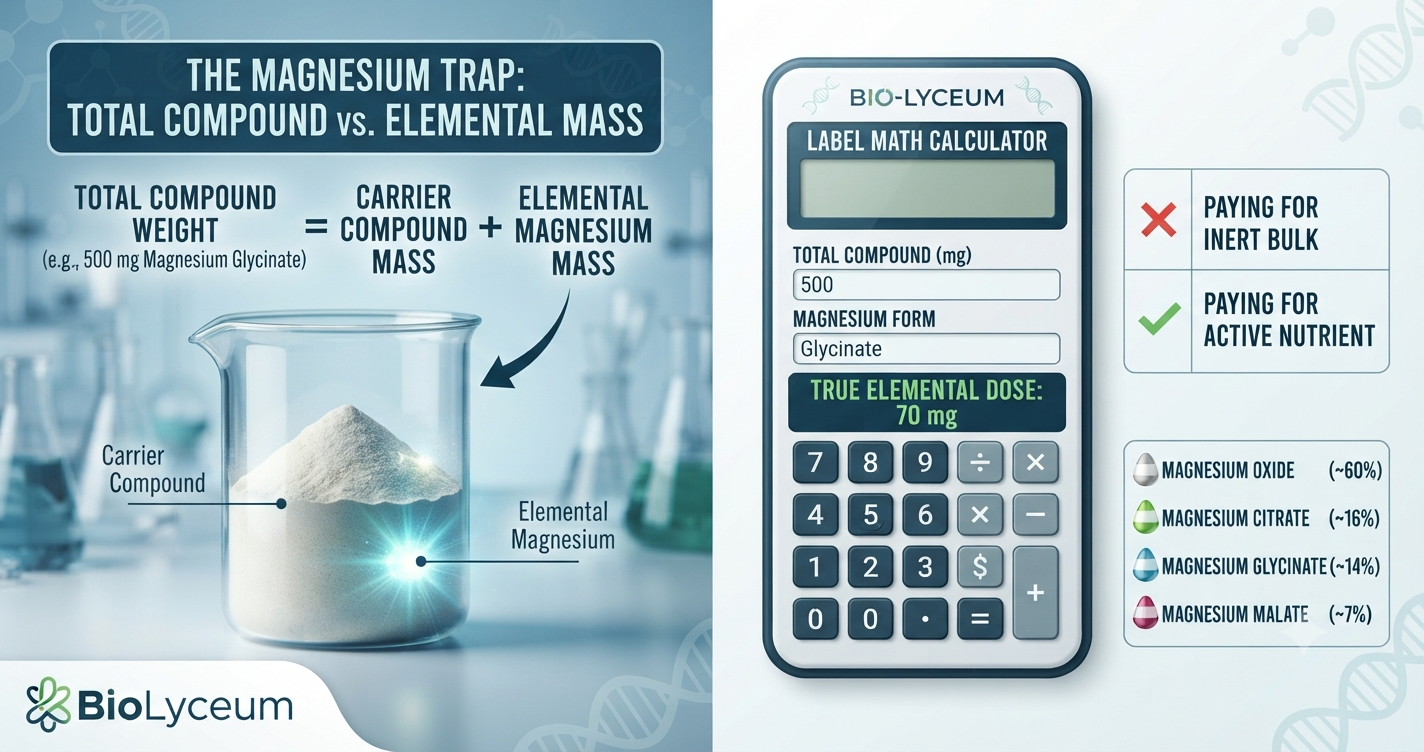
For human consumption, magnesium must be bound to a carrier molecule—a salt, an amino acid, or an organic acid—to stabilize it into a stable compound. When a manufacturer lists “Magnesium Glycinate 500 mg” on a label, that 500 mg represents the total compound weight: the weight of the magnesium atom plus the weight of the attached carrier molecules (in this case, two glycine amino acids).
Think of it like buying a heavy suitcase packed with books. The weight on the airline scale includes both the luggage and the literature inside. If you only want to know how many actual books you are carrying, weighing the entire suitcase is misleading. Similarly, the “books” are your elemental magnesium, while the “suitcase” is the carrier compound.
Different carrier molecules have vastly different molecular weights, which drastically changes the percentage of actual elemental magnesium delivered per milligram of compound:
Magnesium Oxide: A small, lightweight carrier molecule. Because the oxygen atom is very light relative to magnesium, oxide boasts a high elemental yield—roughly 60% by mass. However, as explored in our Magnesium Bioavailability & Form Finder Tool, oxide suffers from abysmal intestinal absorption and acts primarily as an osmotic laxative.
Magnesium Citrate: Bound to citric acid, yielding roughly 16% elemental magnesium by mass. It offers moderate-to-high bioavailability and is commonly used for motility support.
Magnesium Glycinate (Bisglycinate): Bound to two large glycine amino acids. Because glycine molecules have significant molecular heft, the elemental yield drops to approximately 12.5% to 14% by mass. Despite the lower percentage, it boasts superior cellular uptake and negligible gastrointestinal side effects.
Magnesium Malate: Bound to malic acid, yielding roughly 6.5% to 7% elemental magnesium. Highly favored for cellular energy production (Krebs cycle support) in chronic fatigue protocols.
When you fail to account for these ratios, you run straight into the supplement trap.
Step-by-Step Formula: How to Calculate Elemental Magnesium
Let’s pull back the curtain and look at the exact stoichiometry used by biochemists to calculate true elemental dosage.
The mathematical formula is derived from the ratio of the atomic weight of magnesium to the total molecular weight of the bound compound:
Elemental Magnesium = Total Compound Weight of Mg x (Atomic Weight of Mg / Molecular Weight of Compound)

Let’s run a real-life calculation on a ubiquitous product: A standard 500 mg capsule of Magnesium Glycinate.
- Identify the Atomic Weight: Magnesium (Mg) has an atomic weight of roughly 24.305 g/mol.
- Calculate Compound Molecular Weight: Magnesium bisglycinate (Mg(C2H4NO2)2) has a molecular weight of approximately 172.42 g/mol (accounting for anhydrous forms or standard hydrates).
- Determine the Ratio:. 24.305 / 172.42 = 0.141 (or about 14 percent)
- Compute the Final Yield: 500 mg x 0.141 = 70.5 mg of elemental magnesium.
Pause for a moment and let that sink in. When you swallow that massive 500 mg capsule of Magnesium Glycinate believing you are getting half a gram of active nutrient, your systemic circulation is actually receiving roughly 70 milligrams of elemental magnesium. If your daily clinical target is 350 mg of elemental magnesium, taking just one capsule leaves you severely short of your goal.
This mathematical discrepancy catches thousands of consumers off guard every single day. To bypass manual calculations entirely, you can input your product parameters directly into our interactive Magnesium Label Math & Price-per-100mg Calculator, which instantly performs these stoichiometric computations using peer-reviewed molecular weight constants.
Real-Life Anomalies & Marketing Deceptions
The supplement industry operates in a regulatory gray area where clever marketing terminology often obscures biochemical reality. Let’s examine three classic anomalies encountered during independent label audits.
Anomaly 1: The “Proprietary Blend” Smokescreen
Consider a label that reads: “Proprietary Magnesium Matrix (Oxide, Stearate, Aspartate) — 1,000 mg.”
By hiding behind a proprietary blend, the manufacturer legally avoids disclosing the exact milligram breakdown of each individual salt. Because Magnesium Oxide is dirt cheap to manufacture, unscrupulous companies frequently pad 90% of the blend with heavy oxide while sprinkling a negligible, therapeutically useless trace of expensive glycinate or threonate at the bottom of the ingredient list. You pay for a premium compound, but your body receives cheap, unabsorbable bulk.
Anomaly 2: The Hydration Weight Illusion
Chemical compounds love water molecules. Many raw ingredients are sold as hydrates (e.g., magnesium sulfate heptahydrate or magnesium chloride hexahydrate). Water molecules carry heavy oxygen and hydrogen mass that adds dead weight to your supplement powder. If a certificate of analysis fails to distinguish between anhydrous and hydrated forms, your calculated elemental yield can be skewed by 10% to 25%.
Anomaly 3: The Mega-Dose Illusion
A consumer spots a label boasting “2,000 mg Magnesium Complex per serving (4 capsules).” They assume they are mega dosing. However, when you audit the back panel, each capsule contains a bulky amino acid chelate with a low elemental mass ratio, yielding a meager 110 mg of elemental magnesium per capsule—totaling 440 mg for the entire four-capsule dose. It sounds impressive on the front label, but clinically, it is a standard, moderate dose delivered through an inconveniently large pill burden.
If you suspect your current routine is missing the mark, taking our clinically validated Magnesium Deficiency Assessment can help correlate your symptoms with your actual elemental intake.
The Cost-Per-100mg Trap (Are You Overpaying?)
Beyond dosage errors, failing to calculate elemental ratios leads to profound financial waste. Consumers routinely compare prices based on bottle cost rather than cost-per-100mg of elemental magnesium.
Let us look at a comparative market scenario:
Brand A (Magnesium Oxide): Sells a 200-tablet bottle for $10. Each tablet lists 400 mg of oxide compound (~60% elemental yield = 240 mg elemental per tablet). Total elemental magnesium in the bottle: 48,000 mg. Cost per 100mg elemental: $0.02.
Brand B (Magnesium Glycinate): Sells a 120-capsule bottle for $24. Each capsule lists 500 mg of glycinate compound (~14% elemental yield = 70 mg elemental per capsule). Total elemental magnesium in the bottle: 8,400 mg. Cost per 100mg elemental: $0.28.
At first glance, Brand A looks 140% cheaper. But here is where biochemistry intersects with economics: Magnesium oxide has a fractional intestinal absorption rate as low as 4%. The rest remains unabsorbed in your colon, drawing water via osmotic pressure and causing severe diarrhea. You end up flushing your investment straight down the toilet—literally.
To determine true value, you must calculate:
Cost per 100mg Elemental = Total Bottle Price / Total Elemental Magnesium in Bottle (in 100mg units)
When you factor in bioavailability, spending slightly more for a highly absorbed chelate like glycinate or malate ensures that your biological systems actually utilize what you purchase. For deeper comparative insights, explore our complete Magnesium: The Complete Evidence-Based Guide.
The Intracellular Paradox: Why Serum Levels Lie
A recurring anomaly in clinical practice is the patient who presents with textbook symptoms of chronic magnesium deficiency—muscle fasciculations, nocturnal cramping, chronic fatigue, and mild cardiac arrhythmias—yet receives a clean bill of health after a routine serum magnesium blood test.
Why does this disconnect happen?
Standard blood tests measure serum (extracellular) magnesium, which accounts for less than 1% of total body magnesium. The human body is tightly homeostatic; it will ruthlessly leach magnesium out of intracellular storage sites (skeletal muscle and bone mineral matrices) to maintain normal serum levels, because extracellular magnesium is vital for maintaining resting cardiac membrane potentials and preventing fatal tetany.
Relying on a standard serum test to rule out deficiency is like checking the fuel gauge of a car by tasting the oil on the dipstick—it measures the wrong compartment. Understanding this diagnostic nuance allows evidence-based health publishers to capture highly qualified search traffic from patients seeking answers to ambiguous lab results, driving them toward comprehensive educational resources like our Magnesium Testing: A Complete Clinical Guide.
Frequently Asked Questions
Does “Elemental Magnesium” mean total pill weight?
No. Total pill weight includes both the elemental magnesium atom and the carrier salt or amino acid it is bound to. Elemental magnesium represents only the active mineral portion utilized by human physiology.
Why do supplement companies hide the elemental breakdown?
Manufacturers are legally required to list total compound weight on the Supplement Facts panel, but many choose not to highlight the elemental breakdown because lower-cost, bulky compounds have deceptively low elemental yields that look unimpressive to consumers.
How much elemental magnesium do I need daily according to NIH guidelines?
According to National Institutes of Health (NIH) data, the recommended dietary allowance (RDA) for adult men ranges from 400–420 mg daily, and for adult women, 310–320 mg daily, varying by age and pregnancy status.
Conclusion & Clinical Disclaimer
Navigating the supplement marketplace requires skepticism, biochemical literacy, and precise mathematical auditing. Never take a front-label claim at face value. By separating compound weight from elemental dosage and evaluating true cost-per-100mg metrics, you protect both your metabolic health and your wallet.
Medical Disclaimer: All content and tools on BioLyceum are for educational and informational purposes only, based on current peer-reviewed scientific literature. They are not a substitute for professional medical advice, diagnosis, or treatment. Always consult a qualified healthcare provider for medical decisions, especially regarding supplements and pre-existing conditions.
References & Further Reading
National Institutes of Health (NIH) Office of Dietary Supplements. Magnesium Fact Sheet for Health Professionals. Available at: NIH ODS
Rude, R.K. (2012). Magnesium. In: Coates, P.M., et al., eds. Encyclopedia of Dietary Supplements. 2nd ed. New York: Marcel Dekker, pp. 527–37.
Cuciureanu, M., & Vink, R. (2011). Magnesium and stress. In: Vink, R., & Nechifor, M., eds. Magnesium in the Central Nervous System. Adelaide (AU): University of Adelaide Press. DOI: 10.1007/978-0-85729-073-1
Gröber, U., Schmidt, J., & Kisters, K. (2015). Magnesium in Prevention and Therapy. Nutrients, 7(9), 8199–8226. DOI: 10.3390/nu7095388