

The Magnesium Glycinate Label Audit: What 12 Best-Sellers Actually Deliver (2026 Data)
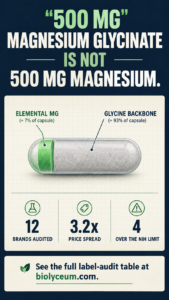
“500 mg of magnesium glycinate” does not mean 500 mg of magnesium. It means 500 mg of a compound that is only about 10–14% elemental magnesium by weight. The number that matters is on the Supplement Facts panel: elemental magnesium per serving. In this audit, that number ranges from 100 mg to 420 mg across twelve best-selling brands — and four of them suggest daily doses above the NIH’s 350 mg supplemental upper limit.
Why “500 mg” Lies: The Elemental Math
The Audit: 12 Best-Sellers, Measured
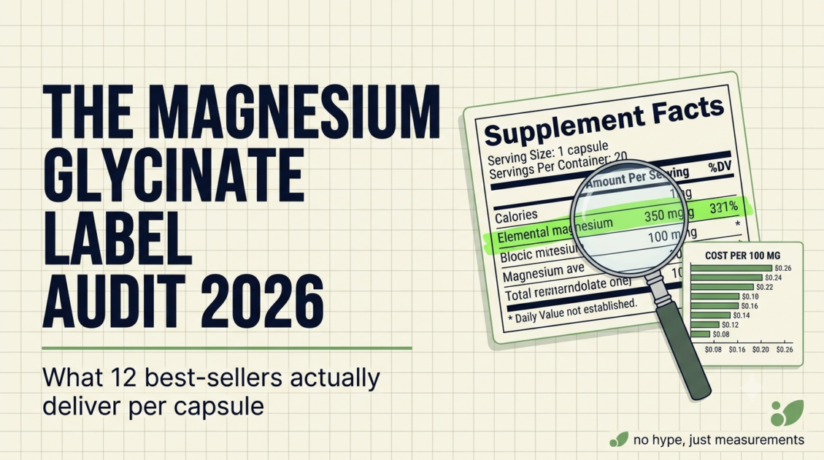
We recorded serving size, declared elemental magnesium, servings per bottle and current price for twelve best-selling magnesium glycinate products, then computed the only two numbers that let you compare them fairly: cost per 100 mg of elemental magnesium, and whether the suggested serving exceeds the NIH Office of Dietary Supplements’ 350 mg/day upper limit for supplemental magnesium.
| Brand | Serving | Elemental Mg/serving | Servings/bottle | Price (USD) | Cost per 100 mg | Suggested dose > 350 mg? |
|---|---|---|---|---|---|---|
| Doctor’s Best | 2 tablets | 100 mg | 120 | $23.99 | $0.20 | No |
| Thorne | 1 capsule | 120 mg | 90 | $26.00 | $0.24 | No |
| Pure Encapsulations | 1 capsule | 120 mg | 90 | $27.00 | $0.25 | No |
| NOW Foods | 2 tablets | 200 mg | 90 | $14.39 | $0.08 | No |
| Nature Made | 3 capsules | 300 mg | 30 | $22.99 | $0.26 | No |
| Jarrow Formulas | 3 capsules | 360 mg | 30 | $16.99 | $0.16 | YES (360 mg) |
| Solgar | 1 capsule | 120 mg | 90 | $21.59 | $0.20 | No |
| KAL | 3 tablets | 315 mg | 80 | $22.19 | $0.09 | No |
| Garden of Life | 2 capsules | 400 mg | 50 | ~$34.00 | ~$0.17 | YES (400 mg) |
| Nature’s Bounty | 2 capsules | 240 mg | 45 | $21.68 | $0.20 | No |
| Carbamide Forte | 2 tablets | 400 mg | 60 | ~$24.00 | ~$0.10 | YES (400 mg) |
| Qunol | 2 capsules | 420 mg | 30 | ~$26.00 | ~$0.21 | YES (420 mg) |
What the table shows:
- Value spread is 3.2×. NOW Foods delivers 100 mg of elemental magnesium for $0.08; Nature Made charges $0.26 for the same 100 mg. Same molecule family, same regulatory framework — different label math.
- Premium price ≠ premium density. Thorne and Pure Encapsulations cost roughly three times NOW per 100 mg. You may still prefer their testing standards — but you are paying for the brand, not for more magnesium.
- Four of twelve (33%) suggest doses above the NIH’s 350 mg supplemental ceiling. Not illegal, not automatically dangerous — but a number worth knowing before you swallow the suggested serving.
- The servings trap: Nature Made’s bottle holds 30 servings; KAL’s holds 80. Price per bottle tells you nothing. Price per 100 mg elemental tells you everything.
Morning or Night? What the Timing Data Actually Says
- For sleep onset, evening wins on mechanism. Magnesium supports GABAergic tone, and the glycine backbone is itself an inhibitory neurotransmitter studied at ~3 g before bed for sleep quality. Note the stoichiometry: 200 mg of elemental magnesium from bis-glycinate carries roughly 1.2 g of glycine — a meaningful fraction, but below the 3 g used in those studies. The sleep benefit is therefore mostly magnesium’s, not glycine’s.
- For daytime calm, consistency beats timing. Serum magnesium responds to total daily intake over weeks, not to the hour of a single dose.
- The protocol we measure against: split the dose — a smaller share with breakfast for baseline calm, the larger share 30–60 minutes before bed for sleep onset. It matches how trials dose (divided servings) and how our readers report the best tolerance. To learn more you can check our complete evidence based Magnesium Guide for further reference
The Dose Map: 200–400 mg Elemental, and the 350 mg Ceiling
Sleep and deficiency-correction trials cluster between 200 and 400 mg of elemental magnesium per day, usually divided. The NIH’s upper limit for supplemental magnesium (not food) is 350 mg/day, set to avoid osmotic diarrhea — the most common real side effect.
Read the audit through that lens: a 200–300 mg elemental daily dose from any row clears the ceiling comfortably. If you follow Jarrow, Garden of Life, Carbamide Forte or Qunol’s suggested serving, you are at 360–420 mg — above the UL. Many healthy adults tolerate this fine; the point is that it should be your choice, made with eyes open, not the label’s default.
Glycinate: vs Citrate: vs Oxide: Absorption and the Bathroom Test
Oxide (~60% elemental): cheapest per milligram, poorest absorbed, strongly osmotic — the classic cause of supplement-induced loose stools.
Citrate (~11–16% elemental): better absorbed, still osmotic at higher doses; often chosen for constipation on purpose.
Glycinate (~10–14% elemental): chelated, gentle on the gut, the default choice when the goal is sleep, calm or long-term repletion without GI drama.
You are not buying “more magnesium” with glycinate; you are buying tolerance and adherence. A supplement you can take nightly for months beats a cheaper one you abandon in week two.
Read Any Label in 30 Seconds: The 4-Point Checklist
- Find the elemental line. Ignore compound weight on the front; read “Magnesium (as magnesium glycinate): X mg.”
- Divide by capsules per serving to get mg per capsule — the unit you actually swallow.
- Compare the suggested serving to 350 mg elemental (the NIH supplemental UL).
- Compute cost per 100 mg elemental: price ÷ (total elemental mg in bottle ÷ 100). Anything above ~$0.25 is paying for the logo.
Safety, Interactions, and Who Should Skip
Kidney disease: impaired excretion makes magnesium accumulation a real risk — supplement only under medical supervision.
Antibiotics and bisphosphonates: magnesium binds tetracyclines, quinolones and bisphosphonates in the gut; separate doses by at least 2–4 hours.
High-dose zinc or calcium taken simultaneously can compete for absorption; space them out.
Pregnancy, medication, or any diagnosis: this audit is measurement, not medical advice — confirm your dose with your clinician.
FAQ
How much elemental magnesium is in magnesium glycinate?
Roughly 10–14% of the compound’s weight. A “500 mg magnesium glycinate” capsule typically delivers 50–70 mg of elemental magnesium; always read the Supplement Facts panel.
Is 400 mg of magnesium glycinate too much?
If that’s 400 mg elemental, it exceeds the NIH’s 350 mg/day supplemental upper limit. Tolerable for many, but choose it deliberately — and check whether your label’s 400 mg is elemental or compound weight.
Should I take magnesium glycinate morning or night?
Split it: a smaller dose with breakfast, the larger dose 30–60 minutes before bed. Evening dosing aligns with its sleep-onset mechanism; total daily intake matters more than the clock.
Can I take magnesium glycinate on an empty stomach?
Yes — glycinate is the gentle form. If you notice any stomach awareness, move the dose to food; unlike oxide or citrate, you lose little by doing so.
How long does magnesium glycinate take to work?
Subjective calm often within days; sleep and deficiency markers in trials shift over 1–4 weeks of consistent daily dosing. Measure weeks, not nights.
Can I take it with melatonin?
Commonly combined and mechanistically compatible; start with the lowest effective dose of each and confirm with your clinician if you take other medication.
Methodology
Brands were selected from current best-seller lists in the US and Indian marketplaces. All figures were transcribed from manufacturer Supplement Facts panels and listed prices in September 2026; prices marked “~” were rounded from marketplace listings. Cost per 100 mg = price ÷ (elemental mg per serving × servings per bottle ÷ 100). Labels are re-verified quarterly; if you spot a formula change, tell us and we will re-measure. For the full beginner’s guide, see our magnesium glycinate supplements guide. And if sound is the other half of your sleep protocol, our sister lab measures that too at SereneSynth where you can get personalized and AI curated sound therapy .
References
- National Institutes of Health, Office of Dietary Supplements. (2025). Magnesium: Fact sheet for health professionals. U.S. Department of Health and Human Services. https://ods.od.nih.gov/factsheets/Magnesium-HealthProfessional/
- de Baaij, J. H., Hoenderop, J. G., & Bindels, R. J. (2015). Magnesium in man: Implications for health and disease. Physiological Reviews, 95(1), 1–46.
- Kirkland, A. E., Sarlo, G. L., & Holton, K. F. (2018). The role of magnesium in neurological disorders. Nutrients, 10(6), 730.
- Abbasi, B., Kimiagar, M., Sadeghniiat, K., Shirazi, M. M., Hedayati, M., & Rashidkhani, B. (2012). The effect of magnesium supplementation on primary insomnia in elderly: A double-blind placebo-controlled clinical trial. Journal of Research in Medical Sciences, 17(12), 1161–1169.
- Held, K., Antonijevic, I. A., Künzel, H., Murck, H., Schuld, A., Yassouridis, A., & Steiger, A. (2002). Oral Mg²⁺ supplementation reverses age-related neuroendocrine and sleep EEG changes in humans. Pharmacopsychiatry, 35(4), 135–143.
- Yamadera, W., Inagawa, K., Chiba, S., Bannai, M., Takahashi, M., & Nakahara, K. (2007). Glycine ingestion improves subjective sleep quality in human volunteers, correlating with polysomnographic changes. Sleep and Biological Rhythms, 5(2), 126–131.
- Firoz, M., & Graber, M. (2001). Bioavailability of US commercial magnesium preparations. Magnesium Research, 14(4), 257–262.
- Walker, A. F., Marakis, G., Christie, E., & Byng, M. (2003). Mg citrate found more bioavailable than other Mg preparations in a randomised, double-blind study. Magnesium Research, 16(3), 183–191.
- BioLyceum Research Desk. (2026, September). Magnesium glycinate label audit 2026 [Data set]. BioLyceum. https://biolyceum.com/magnesium-glycinate-label-audit/
Cite this audit: BioLyceum Research Desk (2026). Magnesium Glycinate Label Audit 2026. BioLyceum.com. Data transcribed from manufacturer Supplement Facts panels, September 2026; re-verified quarterly.