When individuals begin taking magnesium to address chronic fatigue, nighttime muscle cramping, or poor sleep quality, they often expect swift results. When symptoms linger after two weeks of consistent daily supplementation, a common assumption is that the product is ineffective or the dose is inadequate.
However, this frustration usually stems from a fundamental physiological reality: serum magnesium normalization does not equal intracellular tissue saturation.
While circulating blood levels can stabilize in a matter of days, replenishing intracellular skeletal muscle, neural tissue, and bone matrix reserves is a slow biological process requiring weeks or months of steady daily intake.
In this guide, we will break down the multi-compartment kinetics of magnesium transport, explore why standard blood panels routinely miss cellular deficits, and explain how to accurately project your personal repletion roadmap.
Why Standard Serum Tests Lie: The 1% Compartment Problem
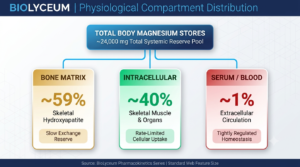
To understand why tissue repletion requires an extended timeline, one must first look at how magnesium is distributed throughout the human body:
Serum & Extracellular Fluid (~1%): Less than 1% of total body magnesium circulates in the blood.
Soft Tissue & Intracellular Compartments (~40%): Located within skeletal muscle, cardiac tissue, and organs.
Bone Matrix Reserves (~59%): Locked within the mineral hydroxyapatite crystal lattice.
Because circulating extracellular magnesium is critical for heart rhythm stability and neuromuscular signaling, the human body tightly regulates serum blood levels between 0.7 and 1.1 mmol/L (1.7 to 2.2 mg/dL).
When dietary or supplemental intake drops, homeostatic mechanisms pull magnesium out of skeletal muscle and bone matrix to keep serum blood concentrations within range. As a result, a standard serum blood test can return a “normal” result even when intracellular tissue stores are severely depleted.
By the time serum magnesium drops below normal reference ranges, widespread cellular depletion has already been present across multiple organ systems for months.
Assessing Intracellular Levels: The Role of RBC Magnesium
To evaluate intracellular status more accurately, functional medicine practitioners rely on Red Blood Cell (RBC) Magnesium testing. Because red blood cells have an average lifespan of 120 days, RBC magnesium levels reflect intracellular saturation over extended periods rather than acute daily fluctuations.
An optimal functional target for RBC magnesium is 5.2 to 6.5 mg/dL. Values falling below 5.0 mg/dL point toward intracellular depletion, regardless of what a standard serum panel indicates. If you suspect your symptoms stem from subclinical deficiency, evaluate your physiological risk markers first using our Magnesium Deficiency Assessment Tool.
The Three Phases of Biological Magnesium Repletion
Replenishing intracellular magnesium follows a structured, three-phase kinetic progression:
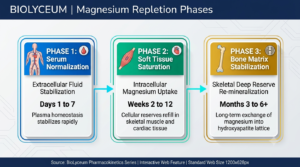
Phase 1: Serum & Extracellular Normalization (Days 1 to 7)
When you begin taking an oral supplement, passive paracellular diffusion and active transcellular transport via TRPM6/7 ion channels absorb elemental magnesium across the intestinal brush border. The absorbed ions enter the bloodstream, rapidly restoring extracellular serum levels.
Extracellular stabilization typically occurs within 3 to 7 days. However, this rapid shift can create a false sense of recovery—your circulating blood is balanced, but your cellular reserves remain empty.
Phase 2: Intracellular Soft-Tissue & RBC Saturation (Weeks 2 to 12)
Once serum levels normalize, active sodium-dependent transport pumps move magnesium ions across cell membranes into intracellular spaces. Skeletal muscle, cardiac tissue, and neural cells gradually refill their internal reserves.
Because cellular uptake is rate-limited to maintain osmotic balance, soft-tissue saturation takes 4 to 12 weeks of steady daily intake. Neuromuscular symptoms such as minor twitches, cramps, and sleep latency usually begin to resolve during this window.
To estimate your exact recovery timeline based on body mass, intake, and physical activity, run your parameters through our interactive Magnesium Tissue Saturation Calculator.
Phase 3: Bone Matrix & Deep Reserve Stabilization (Months 3 to 6+)
The final phase involves re-mineralizing the skeletal bone matrix. Exchange between circulating fluid and bone hydroxyapatite occurs slowly, with a biological exchange half-life of approximately 1,000 hours (~40 days). Fully restoring deep bone matrix reserves and reaching complete systemic balance requires 3 to 6 months of consistent supplementation.
Key Factors That Accelerate or Delay Repletion
Several physiological variables influence how quickly intracellular tissue saturation occurs:
FACTORS INFLUENCING REPLETION
ACCELERATORS (Shorter Timeline)
- Vitamin B6 cofactor co-administration
- Bioavailable amino acid chelates
- Split-dosing throughout the day
DELAYS (Extended Timeline)
- Low-yield magnesium oxide
- Heavy sweat loss / High training
- Medication depletions (PPIs)
1. Compound Bioavailability & True Elemental Yield
The chemical form of your supplement dictates net uptake efficiency:
Inorganic Salts (Magnesium Oxide): Feature a fractional intestinal absorption rate as low as 4% to 5%. Unabsorbed magnesium remains in the digestive tract, drawing water via osmotic pressure and often causing diarrhea.
Organic Amino Acid Chelates (Magnesium Glycinate / Malate): Protect magnesium ions from intestinal precipitation, utilizing dipeptide transport pathways for significantly higher cellular retention.
Before calculating your timeline, confirm that you are measuring true elemental yield rather than bulk compound weight. Learn how to spot hidden label tricks in our cornerstone analysis, The Magnesium Supplement Trap: How to Calculate True Elemental Dosage, or instantly decode your bottle using the Magnesium Label Math Calculator.
If you are unsure which form fits your GI tolerance, compare absorption rates across 10+ forms using our Magnesium Bioavailability & Form Finder Tool.
2. Physical Activity & Sweat Loss Dynamics
Physical activity accelerates daily magnesium turnover. Magnesium acts as a critical cofactor in ATP synthesis and muscle contraction-relaxation cycles. During intense training or high-heat exposure, additional magnesium ions are excreted through sweat and urine. Athletes require a higher daily elemental intake to maintain the net surplus required for tissue repletion.
3. Medication-Nutrient Depletions
Certain prescription medications increase renal magnesium excretion or impair intestinal transport:
Proton Pump Inhibitors (e.g., Omeprazole): Downregulate active intestinal TRPM6 transporter channels.
Loop & Thiazide Diuretics: Increase excretion of magnesium ions in the kidneys.
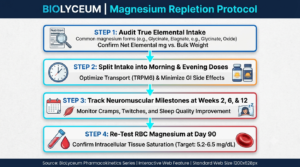
Calculate True Elemental Intake: Base your daily dosage on net elemental magnesium content rather than total compound mass.
Split Daily Intake: Divide your daily target into two doses (e.g., morning and evening). Splitting the dose avoids saturating intestinal transport channels and optimizes overall absorption.
Track Neuromuscular Milestones: Monitor subjective changes in sleep latency, muscle twitching, and exercise recovery at Weeks 2, 6, and 12.
Re-Test via RBC Magnesium at Day 90: If ordering lab work, test RBC Magnesium at the 90-day mark. Avoid retesting standard serum levels, as they do not reflect intracellular saturation progress.
Frequently Asked Questions
Can I speed up tissue saturation by doubling my daily dose?
No. Intestinal transport channels (TRPM6) downregulate when flooded with high single doses. Excess unabsorbed magnesium stays in the intestinal tract, drawing water into the colon and causing diarrhea. Splitting moderate doses twice daily yields far better systemic retention.
Why do muscle cramps return if I stop supplementing after two weeks?
Stopping after two weeks leaves intracellular stores unreplenished. While serum levels may have normalized briefly, muscle tissue remains depleted. Once supplementation stops, circulating blood draws from muscle reserves again, causing symptoms to reappear.
How does magnesium glycinate compare to magnesium citrate for muscle saturation?
Magnesium glycinate utilizes dipeptide transport channels, offering higher bioavailability and greater intestinal tolerance compared to citrate. While magnesium citrate is effective, higher doses exert an osmotic laxative effect, reducing total absorbed elemental magnesium.
Related Research & Tools at BioLyceum
Explore our full suite of interactive tools and evidence-based guides: